



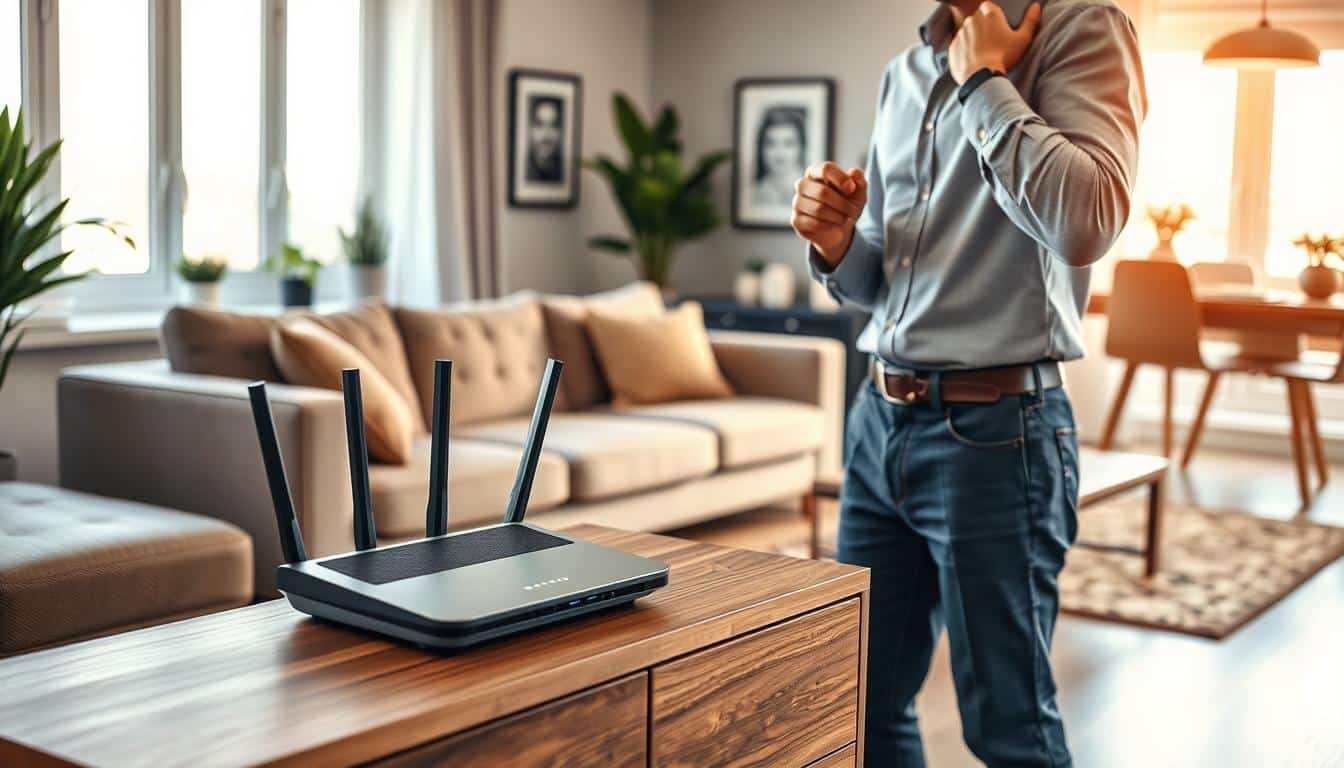
09 Apr Here’s How to Improve WiFi Signal Fast: Effective Tips
A weak WiFi signal can slow down your internet speed and disrupt your daily activities. Poor connectivity frustrates everyone streaming videos, working from home, or browsing social media. You can boost your signal strength without spending thousands of dollars on new equipment.
This guide walks you through practical solutions to improve your WiFi performance. You’ll learn about common problems that weaken your signal. You’ll discover where to place your router for best results.
You’ll also find out how to adjust your router settings for faster speeds. Some fixes take just minutes to complete. Others require a bit more planning.
Key Takeaways
- Router placement matters more than you think for WiFi coverage throughout your home
- Physical barriers like walls and metal objects block WiFi signals and reduce speed
- Changing your WiFi channel can reduce interference from neighboring networks
- Mesh WiFi systems provide better coverage than single routers in large homes
- Securing your network prevents unauthorized users from stealing your bandwidth
- WiFi extenders work best as temporary solutions for small dead zones
- Regular router restarts can fix many connection problems without technical help
Understanding WiFi Signal Degradation and Common Interference Sources
Your WiFi signal travels through your home in invisible waves. Many obstacles can weaken these waves before they reach your devices. Understanding what blocks your signal helps you fix connectivity problems faster.
Different materials absorb or reflect WiFi energy at different rates. Signal problems get worse when waves pass through multiple barriers. Basements and rooms far from routers experience the worst connectivity issues.
Physical Barriers That Block WiFi Signals
Common building materials create serious obstacles for WiFi signals. Standard drywall reduces signal by 3-5 dB, causing approximately 50% strength reduction. Brick walls cause 10-15 dB loss, resulting in 90-97% reduction of signal strength.
Concrete can block 15-20 dB of signal power. Metal surfaces and mirrors reflect signals causing 20+ dB loss. These materials bounce waves away from your devices.
Water presents another major challenge for WiFi signals. Water in aquariums, pipes, or radiators absorbs signals significantly. A single barrier weakens your connection noticeably.
Signal degradation compounds when passing through multiple barriers. This creates severe connectivity problems throughout your home.
Picture a router placed in a basement trying to reach upstairs rooms. It must penetrate both the floor and potentially multiple walls. The kitchen above gets weak WiFi because signals pass through concrete, water pipes, and flooring.
| Material Type | Signal Loss (dB) | Signal Strength Reduction | Impact Level |
|---|---|---|---|
| Standard Drywall | 3-5 dB | Approximately 50% | Mild |
| Brick Walls | 10-15 dB | 90-97% | Severe |
| Concrete | 15-20 dB | 95-99% | Very Severe |
| Metal Surfaces & Mirrors | 20+ dB | 99%+ | Critical |
| Water (Pipes & Aquariums) | Variable | Significant Absorption | Moderate to Severe |
Electronic Devices Causing Signal Interference
Physical barriers are not the only problem affecting your WiFi. Electronic devices in your home create interference that damages network performance. Microwave ovens emit strong 2.4GHz radiation when operating, directly conflicting with WiFi frequencies.
Cordless phones using DECT technology occupy the same airspace as your wireless network. Baby monitors and Bluetooth devices compete for bandwidth on crowded frequencies. Wireless security cameras and neighboring WiFi networks add to the problem.
In apartment buildings, dozens of overlapping networks compete for the same frequencies. Your router tries to communicate while other routers broadcast at full strength nearby.
Watch for warning signs of interference in your network. Periodic disconnections at specific times suggest a device turns on nearby. Speed drops during certain hours point to interference patterns.
- Microwave ovens operating on 2.4GHz frequencies
- Cordless phones using DECT technology
- Baby monitors transmitting wireless signals
- Bluetooth speakers and headphones
- Wireless security cameras
- Neighboring WiFi networks in apartments or condos
- Wireless printers and scanners
- Smart home devices on WiFi bands
The Federal Communications Commission sets guidelines on wireless interference. These guidelines help manufacturers design devices that share frequencies safely. Your WiFi operates in unlicensed spectrum shared with many other devices.
This shared space makes interference inevitable without proper planning. Proper network configuration optimization helps reduce these issues.
Many homes struggle with poor connectivity because they ignore these basic factors. You might blame your internet service provider when physical barriers cause slow speeds. Electronics in your kitchen might be killing your bedroom WiFi.
Optimal Router Placement Strategies for Maximum Coverage
Where you place your router makes a huge difference in WiFi signal strength throughout your home. Poor placement wastes money and leaves dead zones in certain rooms. Getting this right costs nothing but delivers real results.
Position the router as close to the center of your home as possible. This spreads the signal evenly in all directions. For two-story homes, place it on the first floor ceiling or second floor near the stairwell.
Height matters more than many people realize. Elevate the router 5-7 feet off the ground on a shelf or wall mount. Signals propagate better when transmitted from higher positions.
Floor placement causes furniture to block signals and reduces range significantly. Think of WiFi like light—it travels better from elevated positions.
Keep the router away from exterior walls. Your signal should reach inside, not escape outdoors. Interior placement gives you better indoor coverage.
Maintain at least 3-5 feet of clearance from signal-blocking materials. These include metal filing cabinets, large mirrors, fish tanks, and brick fireplaces. Even a small distance helps significantly.
Avoid enclosed spaces like closets, cabinets, or entertainment centers. These create signal-deadening enclosures that trap WiFi energy.
For streaming devices and wireless displays, proper router placement becomes even more critical. You can learn more about wireless display adapters and streaming to understand how placement affects device performance.
| Router Placement Factor | Recommended Action | Signal Impact |
|---|---|---|
| Vertical Height | 5-7 feet off ground | Increases range by 30-50% |
| Horizontal Position | Center of home | Even coverage throughout |
| Distance from Walls | Interior location | Prevents signal loss outside |
| Clearance Space | 3-5 feet from barriers | Reduces interference |
| Enclosures | Avoid closets and cabinets | Eliminates dead zones |
Start by checking your current setup against these guidelines. Moving your router to a better location often solves connection issues without buying anything new. Test different spots for a few hours to see where your devices work best.
- Measure the center point of your home
- Find a shelf or wall mount at proper height
- Move away from dense materials
- Test signal strength in each room
- Adjust placement based on results
Router placement is the foundation of good WiFi performance. Get this right, and you solve many common problems before they start.
How to Improve WiFi Signal Through Router Configuration
Your router’s settings control how your WiFi performs. Many people leave routers set to default configurations, wasting bandwidth and creating weak signals. You can boost your connection by changing two key settings: WiFi channel and transmission power.
Router configuration seems technical, but anyone can do it. You don’t need special skills or knowledge. This guide walks you through each step to strengthen your network.
Selecting the Best WiFi Channel
WiFi channels are like highways for your internet traffic. When many networks use the same channel, congestion slows everything down. Your neighbors’ WiFi likely uses the same channel as yours, creating interference.
The first step is identifying which channels nearby networks occupy. Download a WiFi analyzer tool to scan your area. Popular options include WiFi Analyzer for Android, NetSpot for Windows and Mac, and WiFi Explorer.
Here is how to find the best channel:
- Download and run a WiFi analyzer tool on your device
- Identify which channels have the least traffic from neighboring networks
- Open your browser and log into your router’s admin panel
- Access your router’s wireless settings, usually found under “Wireless Settings” or “Advanced Settings”
- Locate the channel selection option
- Change from “Auto” to a manually selected channel
- Save your settings and reboot the router
- Test your performance improvements
For the 2.4GHz band, the best channels are 1, 6, or 11. These are non-overlapping channels that prevent interference with neighboring networks. The 2.4GHz band has limited options, so choosing wisely matters.
Consider upgrading to the 5GHz band if your router supports it. This band offers many more non-overlapping channels, typically 23 in the US. The 5GHz band experiences less congestion, which means faster speeds and more stable connections.
The tradeoff is that 5GHz has shorter range than 2.4GHz. It works best in smaller spaces or rooms near your router.
| WiFi Band | Non-Overlapping Channels (US) | Range | Congestion Level |
|---|---|---|---|
| 2.4GHz | 3 channels (1, 6, 11) | Longer range | High |
| 5GHz | 23 channels | Shorter range | Low |
Adjusting Transmission Power Settings
Transmission power controls how far your WiFi signal travels. Most routers allow you to adjust this setting between 75% and 100%. Increasing transmission power boosts signal strength throughout your home.
Access your router’s settings menu the same way you did for channel selection. Look for “Transmit Power,” “TX Power,” or “Power Level” in your wireless settings. Set it to maximum or 100% for the strongest coverage.
Higher transmission power uses more electricity but improves signal reach. It helps your WiFi reach every corner of your space.
Proper router configuration can improve WiFi speeds by up to 50% without any hardware changes.
After adjusting transmission power, save your changes and restart the router. Wait two to three minutes for it to fully restart. Run a speed test to measure improvements.
You should notice faster browsing and more reliable connections throughout your home. Combining the right channel selection with maximum transmission power creates a strong, stable network.
Upgrading Your WiFi Hardware for Better Performance
Your router is the backbone of your wireless network. Devices older than five years use outdated WiFi standards that limit speeds. Upgrading to newer hardware delivers dramatic improvements in speed and reliability.
Modern routers handle multiple connected devices far better than older models.
Real-world WiFi speeds typically reach 40-50% of advertised maximums. A router using 802.11n (WiFi 4) delivers around 240-300 Mbps in practice. Jumping to 802.11ac (WiFi 5) gives you roughly 1.4-1.75 Gbps real-world performance.
The leap to 802.11ax (WiFi 6) provides 3.8-4.8 Gbps. That’s six times faster than WiFi 4. For cutting-edge performance, 802.11be (WiFi 7) sets new standards for future-ready networks.
Studies show that upgrading from WiFi 4 to WiFi 6 results in 40-60% speed improvements. In congested environments with many devices, gains reach 75% better performance. This matters when your household has ten or more devices demanding bandwidth simultaneously.
When to Consider a Router Upgrade
You should upgrade your router if any of these situations apply to your home:
- Your current router is more than five years old
- Your internet speeds from your ISP exceed your router’s maximum capabilities
- You experience frequent disconnections or slowdowns
- Your router no longer receives security updates from the manufacturer
- You’ve completed all optimization strategies without satisfactory results
Router Selection by Use Case and Budget
| User Category | WiFi Standard | Recommended Model Type | Price Range | Best For |
|---|---|---|---|---|
| Budget-Conscious Users | 802.11ac (WiFi 5) | AC1900 Routers | $50-80 | Basic web browsing and email |
| Standard Households | 802.11ax (WiFi 6) | AX3000 Routers | $100-150 | Moderate device counts, streaming |
| Power Users | 802.11ax (WiFi 6) | AX5400 or Higher | $200-300 | Large homes, heavy usage |
| Tech Enthusiasts | 802.11be (WiFi 7) or WiFi 6E | Premium Models | $300-600 | Maximum performance, future-proofing |
Key Hardware Specifications to Evaluate
Focus on these critical specifications when shopping for a new router:
- Processor and RAM – These handle simultaneous connections. Look for at least 1 GHz processor and 512 MB of RAM for modern usage patterns.
- Spatial Streams (MIMO) – Choose between 2×2, 3×3, or 4×4 configurations. More streams mean better coverage and speed.
- Band Support – Dual-band routers cover 2.4 GHz and 5 GHz. Tri-band models add a second 5 GHz band for better distribution.
- Ethernet Ports – Gigabit ports ensure fast wired connections for desktops and network storage.
- USB Ports – Enable network-attached storage and printer sharing.
WiFi 6 represents the current sweet spot for price-to-performance value. It provides excellent speed gains without the premium cost of WiFi 6E or WiFi 7. WiFi 6E routers add the 6GHz band, offering better future-proofing.
Your router choice directly impacts everything you’ve optimized so far. Better hardware removes bottlenecks created by older WiFi standards and strengthens your network foundation. Pair a new router with proper network configuration software and tools to unlock full potential.
Consider this upgrade an investment in reliable, fast wireless connectivity for years to come.
WiFi Extenders, Mesh Systems, and Signal Boosters Compared
Your WiFi signal struggles to reach certain rooms. You have several upgrade options available. Understanding the differences helps you pick the right solution for your home.
WiFi extenders receive your existing signal and rebroadcast it to dead zones. Signal boosters work similarly but include amplification components for stronger transmission. Mesh systems use multiple coordinated access points that create a unified network.
When to Choose WiFi Extenders
WiFi extenders work best for specific situations. Choose extenders for small coverage gaps affecting one or two rooms. They fit perfectly in rental properties where permanent installation isn’t allowed.
Extenders make sense on a tight budget. You cannot invest in expensive mesh equipment. They work with any existing router without replacement.
Place the device halfway between your router and the dead zone. Make sure the extender receives at least 50% signal strength. Most extenders have indicator lights showing connection quality.
Setup takes just minutes using the manufacturer’s app. Cost stays low, typically between $30-100 per unit.
Common problems include devices not automatically switching between router and extender. Solve this by using the same SSID and password. Speed reduction happens because extenders use the same channel for receiving and transmitting.
Placement matters greatly for performance. Put your extender too far from the router and speed drops significantly.
Benefits of Mesh Network Systems
Mesh systems offer a more advanced solution for whole-home coverage. These systems consist of multiple coordinated access points working together. You get seamless roaming as devices automatically connect to the strongest signal.
Intelligent band steering directs devices to optimal frequencies. Unified management through smartphone apps provides easy network monitoring and parental controls. Mesh systems with dedicated backhaul maintain full speeds to all connected devices.
| Feature | WiFi Extenders | Mesh Systems |
|---|---|---|
| Cost Per Unit | $30-100 | $200-600 for multi-unit kits |
| Installation Ease | Very easy, no router replacement needed | Requires initial setup and router replacement with mesh base unit |
| Network Names | Create separate SSIDs or cause handoff issues | Single unified network with seamless roaming |
| Bandwidth Impact | Reduces bandwidth by 50% for connected devices | Maintains full speeds with dedicated backhaul |
| Router Compatibility | Works with any existing router | Typically require replacing your primary router with a mesh base unit |
| Coverage Quality | Good for small gaps, moderate performance | Excellent whole-home coverage, consistent speeds |
Budget options include TP-Link Deco M5 or Tenda MW6 at $150-200 for 3-packs. Mid-range systems include Google Nest WiFi or Amazon eero 6 at $250-350. Premium systems like Netgear Orbi or Asus ZenWiFi cost $400-700 for 3-packs.
Setting up requires replacing your existing router with the primary mesh node. Connect it to your modem. Place additional nodes in areas where coverage is needed.
Use the manufacturer’s app to configure the system. Optimize node placement based on signal strength indicators. Maintain some overlap between node coverage areas for best roaming performance.
Mesh systems represent the most comprehensive solution for coverage problems. They require a larger upfront investment compared to extenders. Prices continue declining, making mesh systems more accessible to households.
Antenna Adjustments and Positioning Techniques
Your router’s antenna placement makes a real difference in WiFi coverage. WiFi signals spread strongest perpendicular to the antenna and weakest along the antenna’s direction. This means antenna setup should match your home’s layout and device locations.
The right antenna position can boost your signal strength and expand coverage to dead zones. You won’t need to spend money on new equipment.
Most routers come with multiple antennas. Each antenna works best when positioned differently. Learning how to angle and place them helps you get better coverage throughout your space.
Positioning Strategies for Different Home Types
Your home’s layout matters for antenna placement. Single-story homes and apartments need different setups than multi-story houses.
- Single-story homes: Position all antennas vertically to spread signals across the floor
- Multi-story homes: Mix vertical antennas for same-floor coverage with horizontal antennas for between-floor broadcasting
- Three-antenna routers: Place one vertical and two at 45-degree angles for balanced coverage
- Two-antenna routers: Use one vertical and one horizontal setup
- Four or more antennas: Vary positions to create overlapping coverage patterns
Avoid pointing all antennas in the same direction unless you want focused coverage. Spreading them out creates better overall signal distribution.
Antenna Upgrade Options and Performance Gains
| Antenna Type | Gain Level | Best Use | Coverage Pattern |
|---|---|---|---|
| Stock Router Antennas | 2-5 dBi | Standard coverage | Basic omnidirectional |
| Upgraded Omnidirectional | 7-9 dBi | Single-floor homes | Wide horizontal spread |
| Directional Antennas | 12-15+ dBi | Outdoor or specific areas | Focused beaming |
Antenna upgrades typically increase range by 15 to 30 percent. These upgrades work best for fine-tuning networks that already function well. They cannot replace a better router or mesh system for major coverage problems.
Testing and Optimizing Your Setup
Change one antenna at a time during testing. Use WiFi analyzer apps or run speed tests from different rooms. Document which antenna positions work best in your space.
Your home construction, layout, and interference sources will determine the ideal setup. WiFi signals spread strongest perpendicular to the antenna and weakest along the antenna’s direction.
- Adjust one antenna and wait 30 seconds
- Test signal strength from multiple locations
- Write down the results
- Move to the next antenna
- Compare all configurations
- Keep the best arrangement
Plan your antenna setup based on your home’s layout and device locations. This maximizes performance in the areas you use most often.
Network Security Measures That Improve Signal Quality
Many people overlook how network security directly impacts WiFi performance. Intruders consume bandwidth, processing capacity, and introduce interference that slows your connection. Research shows 2-3 unauthorized users streaming video can degrade network performance by 50-70%.
Security and performance work together in powerful ways. A secure network runs faster because you control who uses your bandwidth. This section walks you through practical steps to lock down your network efficiently.
Preventing Unauthorized Access
Your first step is securing the router itself. Access router security settings through the admin interface using your router’s IP address. Look for the login screen and enter your credentials.
Next, verify that WPA3 encryption is enabled on your wireless network. If your router doesn’t support WPA3, use WPA2 instead. Never use WEP or open networks—these offer almost no protection.
Create a strong network password of at least 12-16 characters. Combine uppercase, lowercase, numbers, and symbols. Avoid common words, names, or easily guessed patterns like “password123.”
Change the default router admin password to prevent unauthorized access to settings. Default passwords are publicly known, making your router vulnerable. Set a unique admin password that differs from your WiFi password.
Disable WPS (WiFi Protected Setup) which has known security vulnerabilities. This feature is convenient but creates security risks. Most modern routers allow you to turn this off in advanced settings.
Enable MAC address filtering as an additional security layer. This feature only allows devices with approved MAC addresses to connect. Keep in mind that determined intruders can spoof MAC addresses.
Hide the SSID (network name) broadcast to make the network less visible. This provides minimal security benefit against determined attackers. This works best combined with other security measures.
Check your router’s connected devices list regularly. Look for sections labeled “Device List,” “Attached Devices,” or “Connected Clients.” Identify unfamiliar devices and disconnect them immediately.
Bandwidth Management for Connected Devices
Once your network is secure, manage how devices share your bandwidth. Too many devices competing for resources slows everything down. Even strong signal strength can’t overcome poor bandwidth management.
Access QoS (Quality of Service) settings in the router admin interface. Look under “Advanced Settings” or “Traffic Management.” QoS lets you prioritize important devices and applications.
| Device Type | Priority Level | Reason |
|---|---|---|
| Video conferencing laptops | High | Work and healthcare require reliable connections |
| Gaming consoles | High | Gaming needs low latency and consistent speed |
| VoIP phones | High | Call quality depends on stable connections |
| Smart TVs | Medium | Streaming quality matters but tolerates minor delays |
| Primary smartphones | Medium | Daily use devices need good performance |
| Security cameras | Low | Background monitoring doesn’t need peak speeds |
| Smart home devices | Low | IoT devices use minimal bandwidth normally |
Use device-based priority to assign priority levels to specific devices. Or use application-based priority for specific traffic types like gaming or streaming. Assign priority levels—High, Medium, or Low—based on household importance.
Enable bandwidth limits for specific devices if needed. This prevents any single device from monopolizing the connection. One streaming device won’t consume all available speed while others wait.
Test your configuration by running bandwidth-intensive activities on multiple devices simultaneously. Verify that prioritized devices maintain performance while others adjust accordingly.
Monitor which devices consume the most bandwidth using your router’s built-in features. Look for unusual patterns like devices with malware consuming excessive data. Watch for streaming devices left running continuously or automatic backups during peak times.
Consider creating a guest network for visitors. This provides internet access while isolating guest devices from your primary network. Guest networks prevent both security risks and bandwidth competition.
Proper security and bandwidth management can improve network performance by 30-50%. This works without changing underlying signal strength. This approach excels in households with many connected devices or shared apartment networks.
Advanced Troubleshooting Methods for Persistent WiFi Issues
Standard WiFi fixes don’t always solve connection problems. Advanced troubleshooting helps you dig deeper into the issue. Start by isolating the problem systematically.
Determine if issues affect all devices or just specific ones. Check if problems occur throughout your home or only in certain spots. Note whether issues happen continuously or at specific times.
This approach helps pinpoint the root cause of your connectivity struggles.
Many users overlook checking their router’s firmware. Outdated firmware creates stability issues and security vulnerabilities. It also causes performance problems that slow down your entire network.
Visit your router manufacturer’s website to download the latest firmware version. Access your router’s admin panel under “Administration” or “System” settings. Look for the firmware update option there.
Always back up your current configuration before updating. Schedule updates during low-usage periods to avoid interruptions.
Test with wired connections to determine if problems stem from WiFi or internet connection. Connect a device directly to your modem using an Ethernet cable. Run baseline speed tests using Ookla Speedtest, Fast.com, or Google speed test.
Test from multiple devices and locations to document actual performance. Compare these wired speeds with your wireless results. If wired speeds are normal, your WiFi system needs attention.
If both show poor speeds, contact your Internet Service Provider about line issues.
Interference identification requires deeper investigation beyond basic channel analysis. Use WiFi Analyzer apps to identify specific interference sources in your area. Test network performance with suspect devices turned off.
Common household items like microwaves, cordless phones, and baby monitors create significant disruptions. These devices operate on similar frequencies as your WiFi. Check for interference from neighboring networks using the same channels.
If 2.4GHz interference proves unavoidable, consider migrating to the 5GHz band. This band offers more available channels and less congestion.
Random WiFi disconnections typically stem from channel interference or outdated firmware. Router overheating and ISP connection instability also cause problems. Document patterns to identify correlations between problems and specific variables.
Note time of day, weather conditions, or active devices. This documentation becomes invaluable during troubleshooting.
| Problem Symptom | Most Likely Cause | Primary Solution |
|---|---|---|
| Fast speed test but slow webpage loading | Slow or unreliable DNS servers | Switch to Google DNS (8.8.8.8), Cloudflare DNS (1.1.1.1), or OpenDNS (208.67.222.222) |
| Random disconnections throughout home | Channel interference or outdated firmware | Update firmware and change WiFi channels |
| Disconnections in specific locations only | Physical barriers or distance from router | Reposition router or install mesh system |
| Slow speeds on all devices | ISP connection issues or router overheating | Ensure router ventilation and contact ISP |
| Slow speeds on bandwidth-intensive tasks only | Network congestion or interference | Change WiFi channels or upgrade hardware |
DNS server issues create unusual symptoms. Your speed tests show excellent results, yet webpages load slowly. ISP-provided DNS servers are often slow or unreliable.
Switch to public DNS services like Google DNS (8.8.8.8 and 8.8.4.4). Cloudflare DNS (1.1.1.1 and 1.0.0.1) and OpenDNS (208.67.222.222 and 208.67.220.220) also work well. Change these settings in your router’s configuration panel or on individual device network settings.
This simple change frequently improves browsing speed without affecting actual internet connection bandwidth.
If problems persist after updating firmware and adjusting DNS settings, perform a factory reset. This removes any corrupted settings that may be causing issues. Before resetting, backup your current configuration to ensure you can restore important details.
Save network names and security passwords. After resetting, reconfigure your router from scratch using earlier steps in this guide.
- Update router firmware regularly through manufacturer websites
- Test with wired Ethernet connections to isolate WiFi problems
- Run baseline speed tests using Ookla Speedtest or Fast.com across multiple locations
- Use WiFi Analyzer apps to identify interference sources
- Switch to public DNS services for faster webpage loading
- Document patterns showing when problems occur and which devices are affected
- Ensure router ventilation to prevent overheating
- Contact your ISP if wired speeds are also poor
Advanced troubleshooting requires patience and systematic testing. Test various configurations and document your findings carefully. You’ll identify the exact cause of your WiFi troubles and implement targeted solutions.
Conclusion
Improving your WiFi signal starts with zero-cost optimizations that require no money upfront. Begin by placing your router in a central, elevated location within your home. This helps the signal reach all areas evenly.
Position your antennas using vertical and horizontal angles if you live in a multi-story home. Remove interference sources like microwaves, cordless phones, and baby monitors. These devices can disrupt your connection.
Next, move on to configuration adjustments that can unlock better performance. Use WiFi analyzer tools to find uncongested channels for your network. Apply WPA3 encryption with strong passwords to secure your connection.
Enable QoS settings to prioritize critical devices and applications that need reliable bandwidth. Consider hardware upgrades like router replacement for overall performance improvement. Mesh systems work well for comprehensive coverage in larger homes.
Conduct a WiFi audit using diagnostic methods to identify specific problems. Look for dead zones, slow speeds, or frequent disconnections. Document your network setup including router location, channel settings, and performance baselines.
Test each solution systematically after implementing it. This helps you track what works for your unique environment. Apartment dwellers benefit most from channel optimization and interference reduction.
Create a maintenance schedule to keep your network running smoothly. Review connected devices quarterly and update firmware every six months. Reassess your hardware yearly to ensure it meets your current needs.
Refer back to diagnostic methodology for troubleshooting persistent issues. Check resources like quick fixes for authentication problems that may affect your network access. Stay informed about WiFi technology developments as new standards emerge.
Sorry, the comment form is closed at this time.